Connect to Datadog
Connect Datadog to Retool and query monitors, metrics, logs, and events.
Datadog is a monitoring and observability platform that unifies infrastructure metrics, application performance data, and logs from cloud and on-premises environments. Teams use Datadog to track system health, set up alerting on monitors, and investigate incidents across distributed services.
What you can do with Datadog in Retool
- Retrieve monitoring data: Query monitors, metrics, logs, and events to surface Datadog data inside Retool apps.
- Manage monitors: Create and update monitors and their alerting thresholds.
- Investigate infrastructure: Search and filter infrastructure hosts and dashboards.
- Build custom tooling: Combine Datadog data with other resources to build observability dashboards and incident response tools.
Before you begin
To connect Datadog to Retool, you need the following:
- Cloud
- Self-hosted
- Datadog API key and application key: A Datadog account with an API key and an application key.
- Retool permissions: Ability to create and manage resources in your organization.
- Datadog API key and application key: A Datadog account with an API key and an application key.
- Network access: Your Retool instance must be able to reach the Datadog API over HTTPS.
- Retool permissions: Ability to create and manage resources in your organization.
Create a Datadog resource
Follow these steps to create a Datadog resource in Retool.
Create a new resource
In your Retool organization, navigate to Resources in the main navigation and click Create new → Resource. Search for Datadog and click the Datadog tile to begin configuration.
Configure general settings
Specify a name and description for the resource that indicates which Datadog account it connects to. The description provides more context to users about how to use the resource.
| Example name | Example description |
|---|---|
| Datadog production | Datadog account for monitoring production infrastructure and services. |
| Datadog staging | Datadog account scoped to the staging environment's monitors and metrics. |
Configure resource credentials
Configure the connection settings for your Datadog resource.
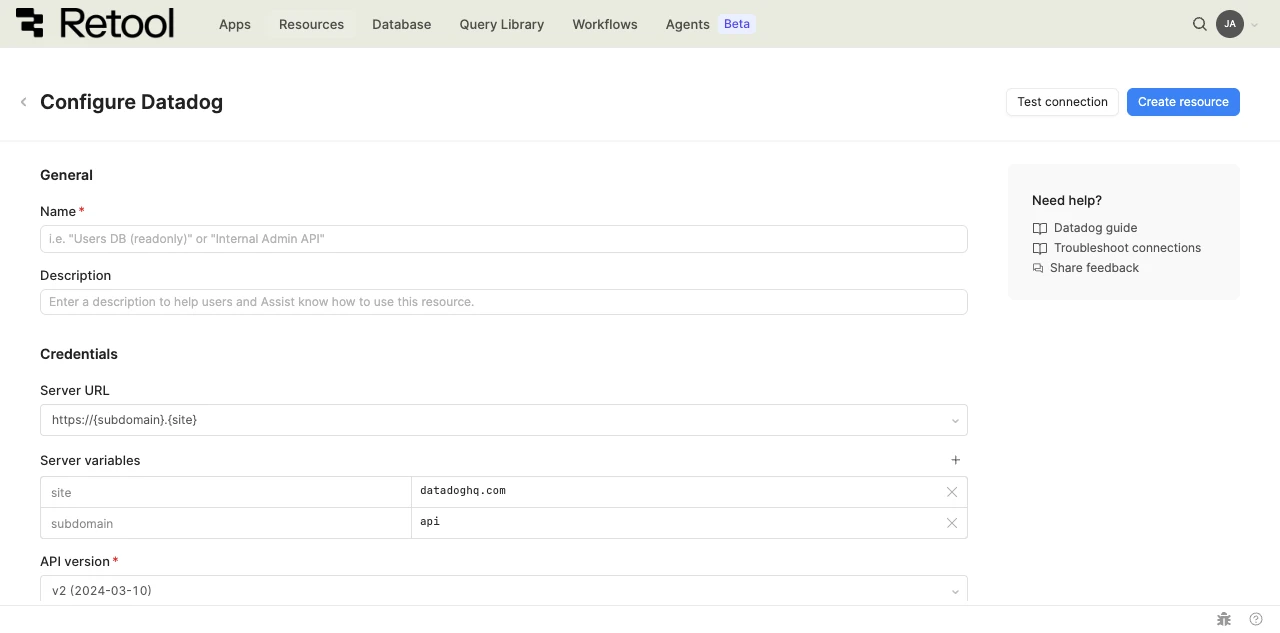
Datadog resource configuration form.
Server URL and server variables
Retool constructs the Datadog API server URL from the site and subdomain server variables. The defaults point to Datadog's standard US site.
https://{subdomain}.{site}
| Field | Value |
|---|---|
| Site | datadoghq.com |
| Subdomain | api |
If your organization uses a different Datadog site (such as the EU site), update the site variable to match your account's domain.
API version
Select the Datadog API version to use. Retool selects a default API version. Choose another version only if your integration requires it.
v2 (2024-03-10) (DEFAULT)
Configure authentication
Datadog resources authenticate with an API key and an application key, both generated from your Datadog account.
API key
Provide your Datadog API key. Retrieve or create one from the API keys section of your Datadog account.
1a2b3c4d5e6f7890abcdef1234567890
Application key
Provide your Datadog application key. Retrieve or create one from the application keys section of your Datadog account.
1a2b3c4d5e6f7890abcdef1234567890abcdef12
Configure advanced options
- Cloud
Outbound region
If your organization uses outbound regions, select the region that should be used for requests to Datadog. This controls which geographic region your requests originate from.
Test the connection
Click Test connection to verify Retool can connect to your Datadog account. If the test succeeds, you see a success message. If it fails, check the following:
- API key and application key are correct: Confirm neither key has been revoked or rotated in your Datadog account.
- Keys belong to the same account: Confirm the API key and application key were generated from the same Datadog account or organization.
- Network access: Ensure your self-hosted instance can reach the Datadog API over HTTPS.
After testing the connection, click View in console to open the Debug Tools console. The console displays request details (URL, method, headers) and the response (status code, body), along with execution time and error details if the test fails.
Save the resource
Click Create resource to save your Datadog resource. You can now use it in queries across your Retool apps and automations.
Interact with Datadog data
Once you've created a Datadog resource, you can interact with Datadog data using Retool.
Retool recommends using the new app builder so you can use natural language to build React-based apps using AI.
- To use Datadog data in the app builder, reference the resource in the prompt with
@, such as@Datadog production. Refer to the data and functions documentation to learn more. - For classic apps, workflows, and agents, refer to the REST API queries documentation to learn how to write a resource query.
Best practices
Follow these best practices to maintain the security of your Datadog resource.
- Store credentials securely: Retool encrypts your Datadog API key and application key automatically, so you don't need to route them through a separate secrets store.
- Rotate credentials regularly: Rotate the API key and application key periodically from your Datadog account, and immediately if either is ever exposed.
- Apply least privilege: Use a Datadog application key scoped to a role with only the permissions a given resource needs, instead of an admin-level key.
- Use resource environments: Organizations on an Enterprise plan can configure multiple resource environments to maintain separate Datadog credentials for production, staging, and development.
Related resources
Create a resource
Learn how to create and manage resources in Retool.
Resource environments
Configure separate credentials for production and non-production environments.
Configuration variables
Store sensitive values securely for use in queries and apps.
Retool community: Datadog
Community discussions and solutions for Datadog integrations.
Datadog API documentation
Official Datadog API documentation.