Changelog

Updates, changes, and improvements at Retool.

Refer to the stable and edge release notes for detailed information about self-hosted releases.

22 posts tagged with "Cloud"

View All Tags

Admin onboarding hub now available in the Settings Overview page

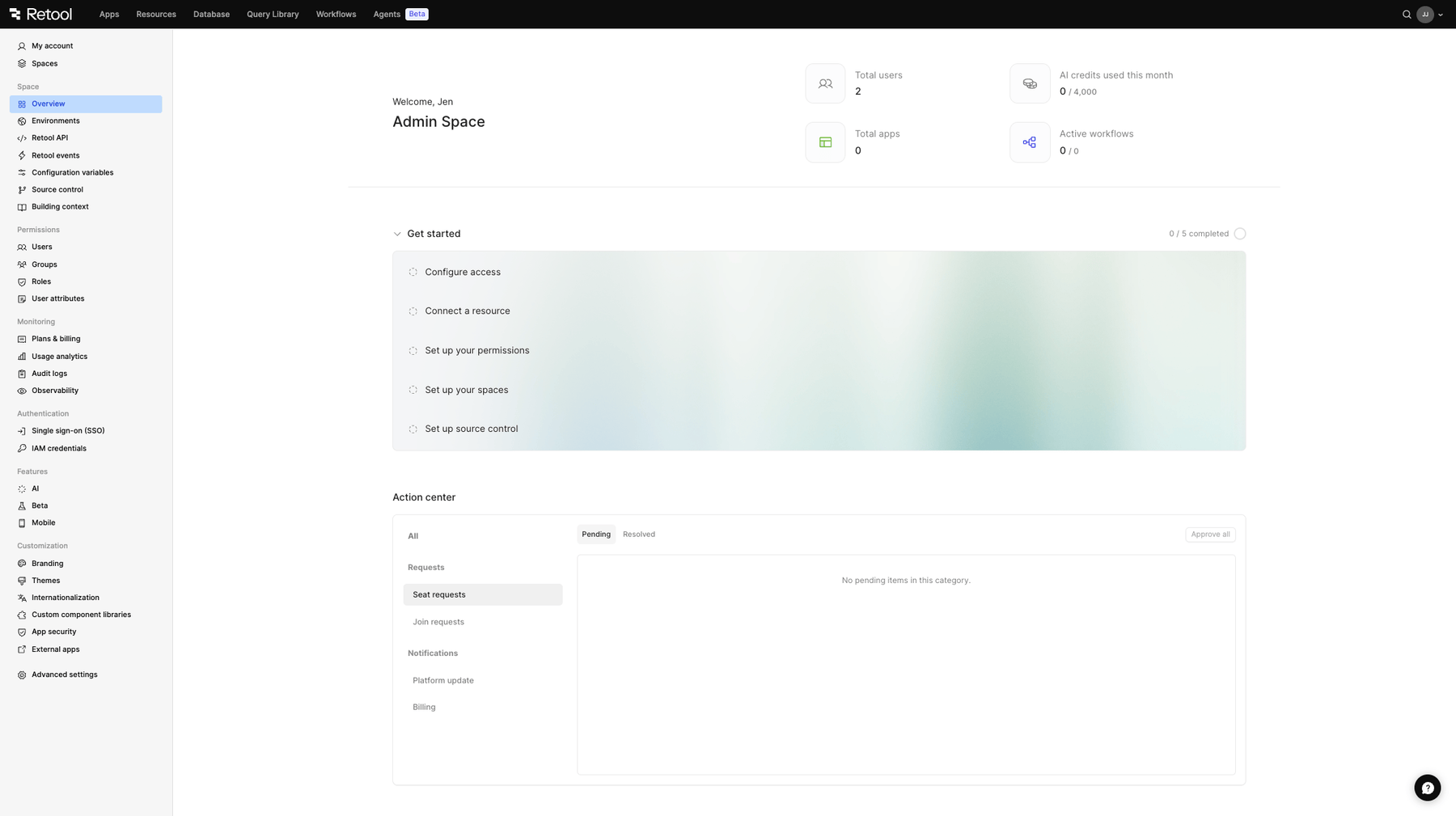
Admins on the Enterprise plan can now complete each step in the Get started section of the Overview page using guided step-by-step wizards instead of navigating through separate Settings pages to complete configuration.

Overview page

You can now directly configure from the Overview page:

  • SSO
  • Resources
  • Source control
  • Spaces
  • Permissions
note

The Permissions setup step is only available to organizations with object roles enabled. If object roles are not enabled for your organization, this step will be hidden. Refer to Object roles for more information.

The Get started section is aimed at providing a better onboarding experience for admins of new organizations, and will help identify what configurations still need to be set up for admins or existing organizations. For example, setting up spaces walks you through choosing custom spaces or a Dev/Staging/Prod environment split, naming and configuring each space, and optionally copying over your existing SSO settings, before creating every space at once.

The Overview page also includes an Action center that contains important notifications and pending join requests, suggested users, and seat upgrade requests, so admins can act on what needs attention, as well an at-a-glance overview of your organization stats, such as total users, apps, workflows, and AI credit usage.

Deprecation of Microsoft SQL integration versions 1.0 and 2.0

Retool is deprecating versions 1.0 and 2.0 of the Microsoft SQL integration. Organizations with Microsoft SQL resources still using these versions must update their resource configuration to use version 3.0.

This deprecation will first take effect on cloud instances on August 24, 2026. It will then take effect in the next edge and stable releases that follow.

Version 3.0 has been available since February 2, 2026 for cloud instances and the 3.334 stable release. If you haven't intentionally created a resource on an older integration version, your resource is likely already on version 3.0 and requires no changes.

To upgrade an existing resource, open its settings from the Resources page, change Connector version to Version 3.0, and save your changes.

Versions 1.0 and 2.0 will be removed entirely from cloud instances in Q4 2026, followed by the subsequent edge and stable releases. After that, apps, workflows, and queries that depend on Microsoft SQL resources still using version 1.0 or 2.0 will stop working.

Settings navigation bar reorganization

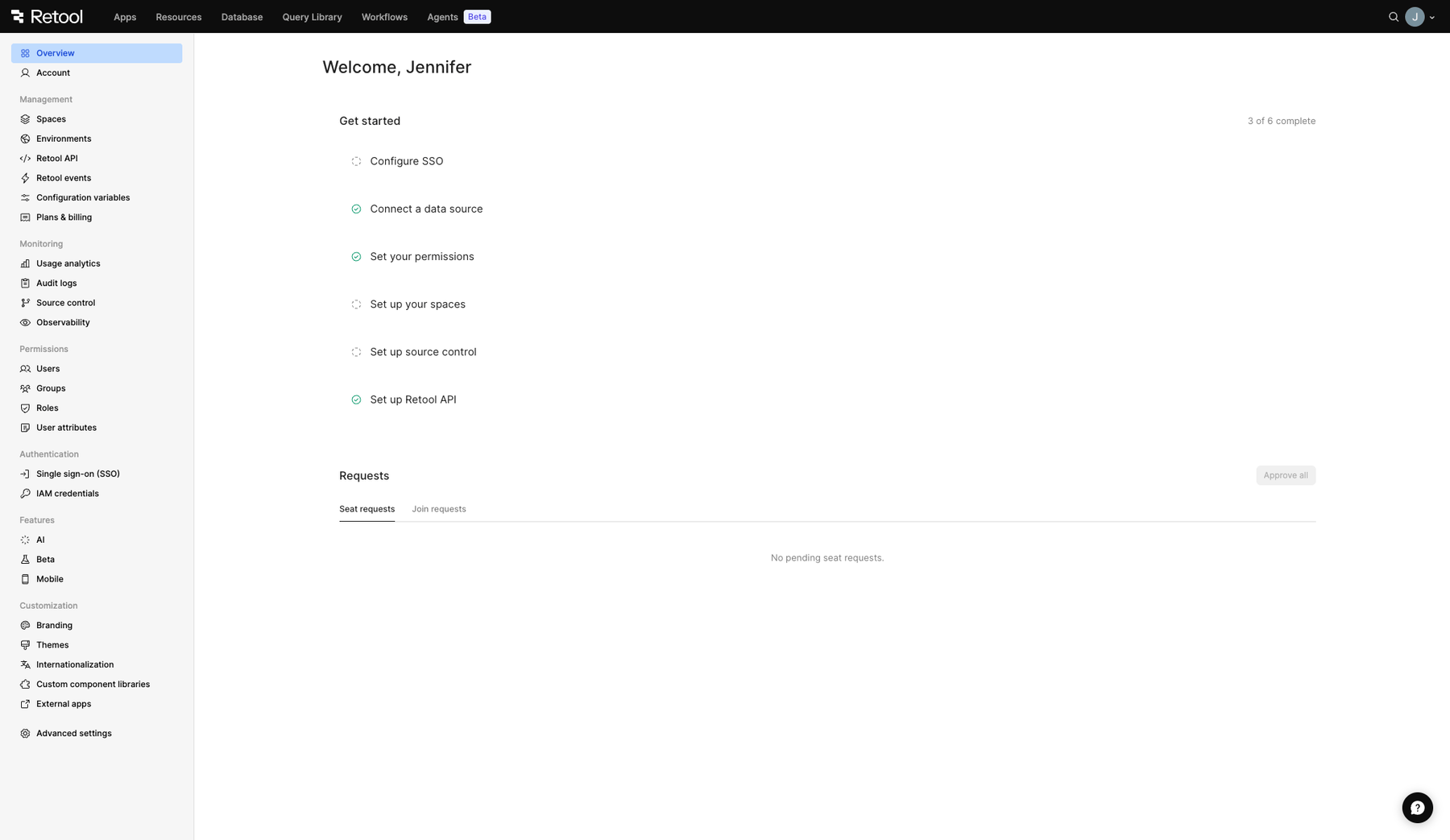
The Settings navigation is reorganized into clearer, task-based groups so you can find what you need more quickly.

Settings are now grouped under the following sections: Management, Monitoring, Permissions, Authentication, Features, and Customization. For example, Users, Groups, Roles, and User attributes are grouped under Permissions, while Single sign-on (SSO) and IAM credentials are grouped under Authentication.

Settings navigation update.

New Overview page in Settings

Admins can now use the Overview page in Settings to set up their Retool organization and respond to pending user requests.

The Get started section guides you through configuring the core areas of your organization, including single sign-on (SSO), resources, permissions, spaces, source control, and the Retool API.

Retool marks each step as complete once you configure it, and you can mark any step that does not apply as not relevant. The module is hidden once you complete the Get started steps.

The Overview also surfaces pending join requests and suggested users, so you can approve new members without leaving the page.

Python runtime version selector and 3.14 availability

You can now select the Python version used by a workflow from the Languages & Libraries tab. Click ... next to Python, select Update version, and choose between Python 3.10 and 3.14.

Python 3.14 does not include built-in libraries. When you upgrade, Retool automatically identifies any built-in libraries your workflow uses and installs them as custom libraries.

Unpublish a workflow release

You can now unpublish workflow releases from the Releases tab.

This feature is also available for workflows protected with Source Control. When unpublishing a release on a protected workflow, the latest saved version on the main branch will be live to users.

Agents supports A2A protocol

The Agent-to-agent (A2A) protocol provides standardized and secure communication between external agents and agents built with Retool, so you can trigger your agent from an external agent, or embed agents in your own systems.

Note

Currently, Retool supports ingress into Retool agents from an external agent.

Retool has implemented the core set of A2A functionality, so you can:

  • View an agent card.
  • Send a message.
  • Poll for updates on tasks.
  • Stream processing or task updates via Server-Sent Events (SSE).
  • Cancel tasks.

To allow external agents to communicate with Retool agents, you can enable the A2A trigger on your agent's configuration page, and copy the endpoint and API key into your A2A client. The A2A client then sends messages via common messaging formats like the HTTP+REST and JSON-RPC APIs, and Server-Sent Events (SSE) for long-running streaming updates.

Explore the following pages for more information:

Unpublish a workflow release

You can now unpublish workflow releases from the Releases tab.

note

Reach out to your account manager to enable unpublish for workflows.

This feature is also available for workflows protected with Source Control. When unpublishing a release on a protected workflow, the latest saved version on the main branch will be live to users.

Create README files for workflows

You can now create a README from the workflow IDE to help clarify important information about your workflow for collaborators. For example, if a workflow requires certain permissions on a resource, or if it's only scheduled to run once a week.

This feature is also available for workflows protected with Source Control. To create a README, click the title of the workflow and add content to the Editor README field. READMEs are visible from the Edit workflow details dialog box, in workflows JSON exports, and in a markdown file from source control.

Source Control available for Agents

note

This change is available on cloud instances and self-hosted instances on version 3.284.0 and later.

To enable Source Control for Agents in version 3.284.0 or 3.284.1, reach out to your account manager.

In version 3.284.2, Source Control for Agents is available by default, and admins can disable it in Settings > Beta by toggling the AI Agents Source Control feature flag.

You can protect an agent with Source Control from the dropdown next to the agent name, or from the dropdown on the All agents page.

Source Control for agents operates similarly to how it does for apps, but with some key differences.

  • Agents cannot be moved or renamed. Protected agents and the folders in which they're located cannot be renamed or moved. You must unprotect agents before making name or location changes. Protected agents must have a unique name.
  • Agent triggers cannot be protected. You can edit the trigger of a protected agent without creating a commit.
  • Evals and Datasets are incompatible. You cannot access evals and datasets from a protected agent.