Connect to CockroachDB
Connect CockroachDB to Retool to query data, manage records, and build apps and automations with SQL.
CockroachDB is a relational database management system. You can create a CockroachDB resource to securely connect to your databases and create apps and automations that use SQL queries to perform create, read, update, and delete operations.
What you can do with CockroachDB in Retool
- Query with SQL: Write SQL queries with joins, aggregations, subqueries, common table expressions (CTEs), window functions, and CockroachDB-specific functions using SQL mode for reading data.
- Manage data: Insert, update, and delete records using GUI mode for write operations.
- Execute transactions: Perform multi-statement transactions with automatic rollback on errors.
- Call functions: Execute CockroachDB functions and stored procedures with parameters and return values.
- Work with advanced types: Query and manipulate
JSONBcolumns, arrays,hstore, and other CockroachDB data types.
Before you begin
To connect CockroachDB to Retool, you need the following:
- Cloud
- Self-hosted
- CockroachDB database: An accessible CockroachDB instance.
- Network access: Your CockroachDB server must accept connections from Retool's IP addresses.
- Database credentials: Username and password with appropriate permissions.
- Retool permissions: Ability to create and manage resources in your organization.
- CockroachDB database: An accessible CockroachDB instance.
- Network access: Your Retool instance must be able to reach your CockroachDB server.
- Database credentials: Username and password with appropriate permissions.
- Retool permissions: Own permissions for resources in your organization.
Create a CockroachDB resource
Follow these steps to create a CockroachDB resource in your Retool organization.
1. Create a new resource
In your Retool organization, navigate to Resources in the main navigation and click Create new → Resource. Search for CockroachDB and click the CockroachDB tile to begin configuration.

CockroachDB resource selection.
Use folders to organize your resources by team, environment, or data source type. This helps keep your resource list manageable as your organization grows.
2. Configure general settings
Specify a name and description for the resource that indicates which database it connects to. The description provides more context to users about how to use the resource.
| Example name | Example description |
|---|---|
User database (readonly) | A read-only CockroachDB database that contains information about all registered users. |
Orders database | A read/write CockroachDB database with customer order data. |
3. Configure resource credentials
Configure the connection settings for your CockroachDB resource.
You can autofill the configuration fields using a CockroachDB connection string.
cockroachdb://username:password@host:26257/dbname
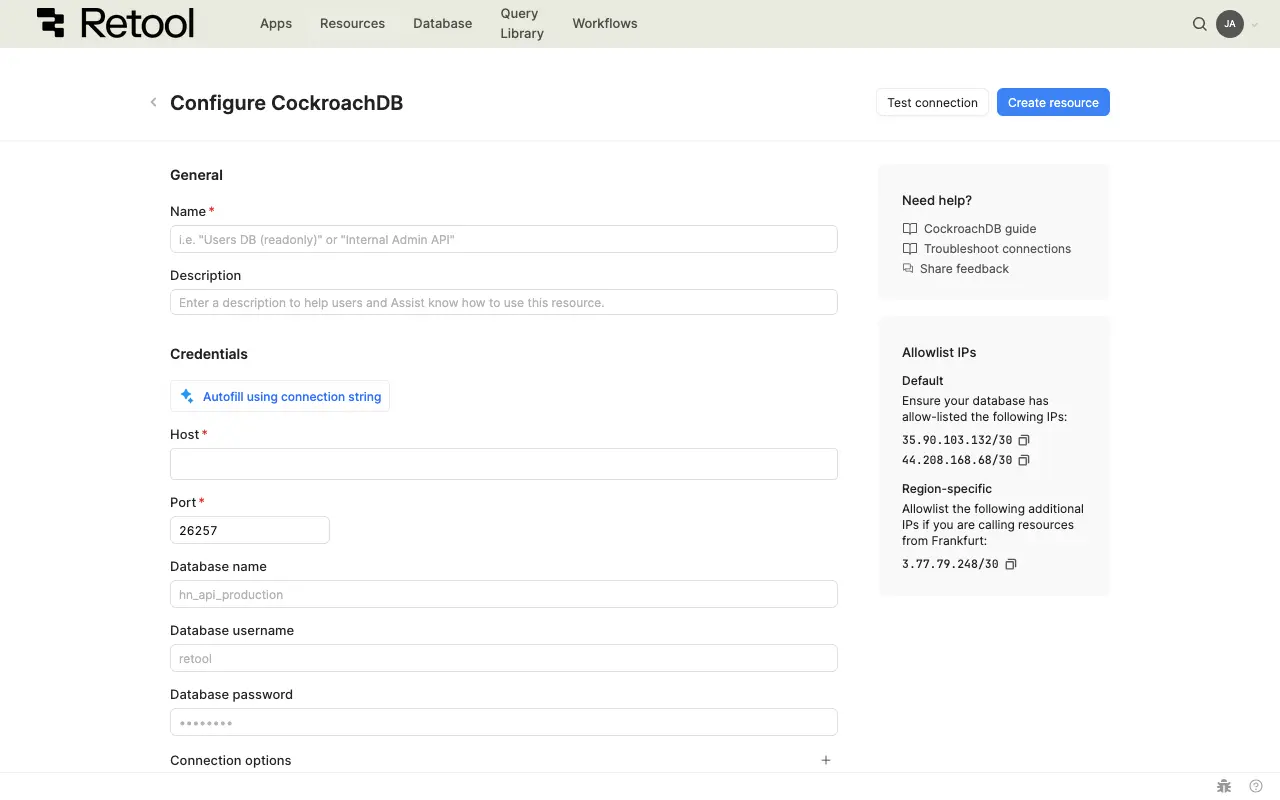
CockroachDB connection settings.
Host
The hostname or IP address of your CockroachDB server.
mydb.abc123.jxf.gcp-us-central1.cockroachlabs.cloud
cdb-instance.c.my-project.internal
cdb.example.com
192.168.1.100
Port
The port number for your CockroachDB server. Default is 26257.
Database name
The name of the database to connect to on the CockroachDB server. Leave blank to connect to the default database.
Connection options
Additional connection parameters for CockroachDB. Add custom connection options as query parameters.
search_path=public,app_schema
application_name=retool
statement_timeout=30000
4. Configure authentication
CockroachDB supports authentication using Username and password. For sensitive values like passwords and access keys, use configuration variables or Retool secrets rather than hardcoding them.
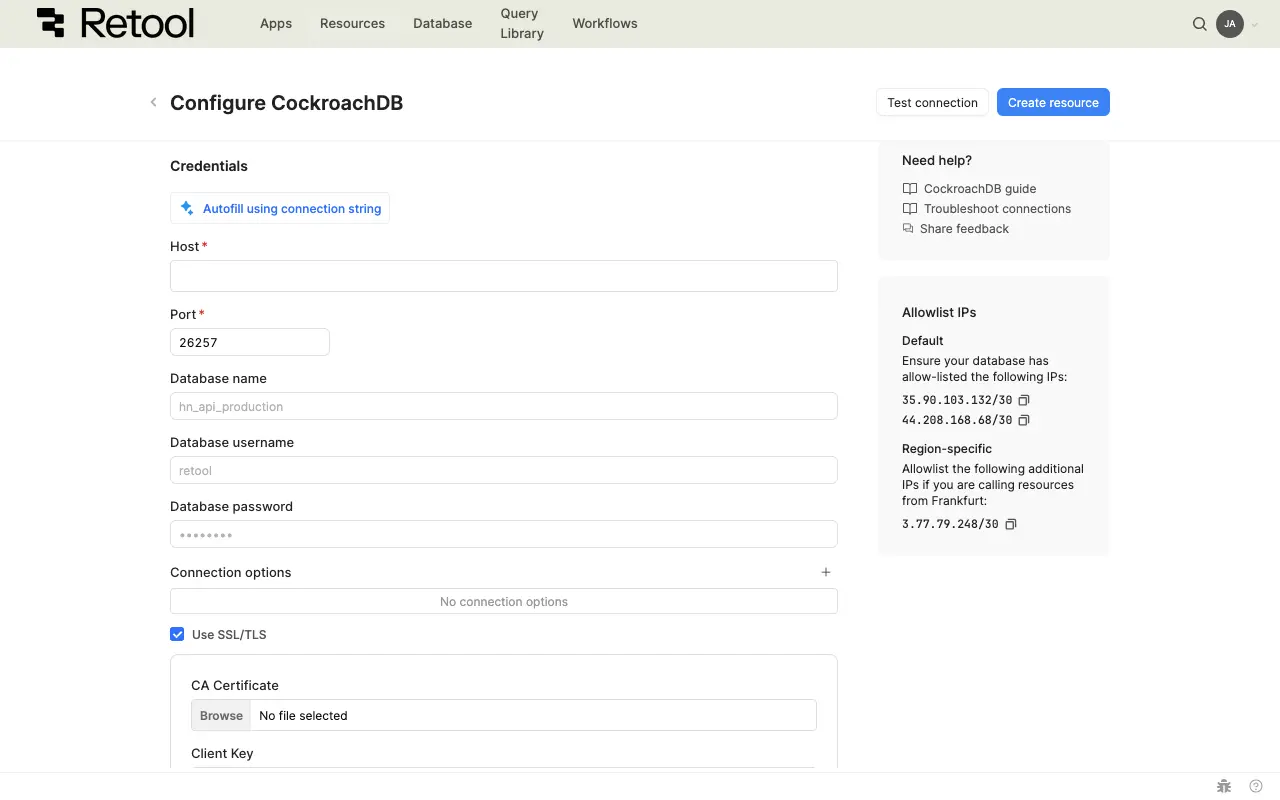
CockroachDB authentication settings.
5. Configure advanced options
Configure optional settings available under the Advanced options section of the resource configuration form.
Outbound region
- Cloud
- Self-hosted
If your organization uses outbound regions, select the region that should be used for requests to CockroachDB. This controls which geographic region your requests originate from, which is useful for reducing latency or meeting data residency requirements.
Self-hosted instances do not have the outbound region field. Connections originate from your Retool instance's network.
SSL/TLS
Configuring SSL/TLS is optional but highly recommended for encrypted connections to your CockroachDB server.
| Field | Description |
|---|---|
| SSL/TLS | Enable SSL/TLS encryption for the connection. |
| SSL host | Override the hostname used for SSL certificate verification. Useful when connecting through proxies or load balancers. |
| Reject unauthorized | Reject connections if the server's SSL certificate cannot be verified. Enabled by default for security. |
| CA certificate | Provide your certificate authority (CA) certificate for SSL verification. |
| Client certificate and key | For mutual TLS authentication, provide client certificate and private key. |
| GCP self-signed cert | For Google Cloud SQL, enable this option to connect with self-signed certificate support. |
For cloud databases SSL certificates may be required. Download the appropriate CA certificate from your cloud provider's documentation.
6. Test the connection
Click Test connection to verify Retool can connect to your CockroachDB database. If the test succeeds, you see a success message. If it fails, check the following:
- Network access: Ensure your CockroachDB server accepts connections from Retool's IP addresses or your self-hosted instance.
- Credentials: Verify username and password are correct.
- Firewall rules: Check that firewall rules allow traffic on the CockroachDB port (default
26257). - Cluster setting: Ensure the CockroachDB cluster settings allows connections from Retool's IP addresses.
- SSL configuration: If SSL is required, verify SSL settings match your server's requirements.
After testing the connection, click View in console to open the Debug Tools console. The console displays detailed information about the test, including the test query executed and its response, execution time, and error details if the test fails. This information is helpful for troubleshooting connection issues.
7. Save the resource
Click Create resource to save your CockroachDB resource. You can now use it in queries across your Retool apps and automations.
Query CockroachDB data
Once you've created a CockroachDB resource, you can query CockroachDB data in your Retool apps and automations.
Create a query
To create a CockroachDB query in a classic app:
- In the Retool app IDE, open the Code tab, then click + in the page or global scope.
- Select Resource query.
- Choose your CockroachDB resource.
- Write your SQL query to read data, or use GUI mode for write operations (insert, update, delete).
Action types
CockroachDB queries support two modes: SQL mode for reading data with custom SQL queries and GUI mode for write operations. In GUI mode, you can select from multiple action types for different write operations.
| Action type | Description | Use case |
|---|---|---|
| Insert a record | Add a single new row to a table. | Create records from form submissions. |
| Update an existing record | Modify an existing row identified by primary key or filter. | Edit individual records with inline editing. |
| Update a record, or create a new record if it doesn't exist | Update an existing record or create a new one if the record doesn't exist. | Upsert operations based on filter criteria. |
| Delete a record | Remove rows based on filter criteria. | Delete records with confirmation. |
| Bulk insert records | Add multiple new rows to a table in a single operation. | Bulk create records from imported data. |
| Bulk update via a primary key | Update multiple records identified by primary key. | Batch update operations. |
| Bulk upsert via a primary key | Insert or update multiple rows based on a primary key. | Import data that may contain new or existing records. |
Query configuration fields
Configuration fields vary based on the mode and action type you select. Field values can be static (e.g., user_123) or dynamic by using an embedded expression (e.g., {{ userSelect1.value }}).
SQL mode
For reading data with custom SQL queries.
SQL query
The SQL statement to execute.
simple select
SELECT * FROM users
WHERE created_at > NOW() - INTERVAL '7 days'
ORDER BY created_at DESC
LIMIT 100
joins and aggregations
SELECT
  u.id,
  u.name,
  u.email,
  COUNT(o.id) as order_count,
  SUM(o.total) as total_spent
FROM users u
LEFT JOIN orders o ON u.id = o.user_id
GROUP BY u.id, u.name, u.email
HAVING COUNT(o.id) > 0
ORDER BY total_spent DESC
common table expression (CTE)
WITH recent_orders AS (
  SELECT user_id, SUM(total) as total_spent
  FROM orders
  WHERE created_at > NOW() - INTERVAL '30 days'
  GROUP BY user_id
)
SELECT u.name, u.email, ro.total_spent
FROM users u
JOIN recent_orders ro ON u.id = ro.user_id
WHERE ro.total_spent > 100
window functions
SELECT
  user_id,
  order_date,
  total,
  ROW_NUMBER() OVER (PARTITION BY user_id ORDER BY order_date) as order_number,
  SUM(total) OVER (PARTITION BY user_id ORDER BY order_date) as running_total
FROM orders
parameterized query
SELECT * FROM products
WHERE category = {{ dropdown1.value }}
  AND price BETWEEN {{ minPrice.value }} AND {{ maxPrice.value }}
  AND name ILIKE {{ '%' + searchInput.value + '%' }}
ORDER BY price ASC
GUI mode
For write operations using the graphical interface.
Action type
Select from the action types listed in the Action types table above.
Table name (all action types)
The database table to query.
// Static table name
users

// Dynamic table name
{{ dropdown1.value }}
Records
Applies to: Insert multiple records, Bulk upsert by key.
The data to insert or upsert.
{{ table1.data }}
{{
  fileInput1.parsedValue.map((row) => ({
    name: row.Name,
    email: row.Email,
    status: "active",
  }))
}}
Filter by
Applies to: Update an existing record, Update/create if not exists, Delete a record.
The WHERE clause conditions for filtering rows.
{{ { status: "active", role: roleSelect.value } }}
Primary key column
Applies to: Update a record, Delete a record, Bulk upsert by key.
The column used as the primary key for identifying records.
// Primary key column name
id

// Composite key (for bulk upsert)
["user_id", "product_id"]
Changeset
Applies to: Update a record, Update multiple records.
The columns to update with new values.
{{ table1.changesetObject }}
{{ form1.data }}
Data types and formatting
CockroachDB queries return and accept specific data types. Understanding these formats helps you work with CockroachDB data effectively in Retool.
Request data formats
When sending data to CockroachDB, use these formats for different value types:
| Value type | Description | Example |
|---|---|---|
| Strings | Use single quotes in SQL or embedded expressions. | 'text value' or {{ textInput.value }} |
| Numbers | Provide numeric values directly. No quotes needed. | 123 or 45.67 |
| Booleans | Use TRUE or FALSE in SQL. | TRUE or {{ checkbox.value }} |
| Dates | Use ISO 8601 format strings or CockroachDB date functions. | '2025-01-21' or NOW() |
| Timestamps | Use ISO 8601 format with timezone or CockroachDB timestamp functions. | '2025-01-21T10:30:00Z' or CURRENT_TIMESTAMP |
| NULL values | Use NULL keyword in SQL or null in embedded expressions. | NULL or {{ textInput.value }} |
| JSON/JSONB | Use JSON strings or JavaScript objects. | '{"key": "value"}' or {{ JSON.stringify(object1.data) }} |
| Arrays | Use CockroachDB array syntax or JavaScript arrays. | ARRAY[1,2,3] or {{ [1, 2, 3] }} |
Response data formats
CockroachDB queries return data in these formats:
| Data type | JavaScript type | Notes |
|---|---|---|
| Integer types | number | Returns JavaScript numbers. |
| Numeric/Decimal | string | Returns as strings to preserve precision. Parse with parseFloat() if needed. |
| Text/VARCHAR | string | Returns as JavaScript strings. |
| Boolean | boolean | Returns true or false. |
| Date | string | Returns ISO 8601 date string (e.g., 2025-01-21). |
| Timestamp | string | Returns ISO 8601 timestamp string with timezone. |
| JSON/JSONB | object | Automatically parsed to JavaScript objects. |
| Arrays | array | CockroachDB arrays become JavaScript arrays. |
| NULL | null | Returns JavaScript null. |
Common use cases
The following examples demonstrate typical CockroachDB operations in Retool apps.
read and display data in a table
First, create a query named tableQuery and write an SQL statement to retrieve some data.
SELECT id, name, email, status, created_at
FROM users
WHERE status = 'active'
ORDER BY created_at DESC
LIMIT 100
Next, add a Table component to the app and set its Data property to {{ tableQuery.data }}. The table dynamically updates to reflect the data structure provided by the query.
filter data with user input
First, add input components for users to specify search filters.
- A Text Input component (
searchInput) for search terms. - A Select component (
statusSelect) for status filtering. - A Date Range Picker component (
dateRange) for date filtering.
Next, write a query that references the input component values to filter data.
SELECT id, name, email, status, created_at
FROM users
WHERE
  name ILIKE {{ '%' + searchInput.value + '%' }}
  AND status = {{ statusSelect.value }}
  AND created_at BETWEEN {{ dateRange.value.start }} AND {{ dateRange.value.end }}
ORDER BY created_at DESC
Queries that read data automatically run whenever any referenced input values change by default. As you update the input fields, the query retrieves new data based on the new values.
insert new rows from a form
Add a Form component (form1) with input fields for the data you want to collect (name, email, role).
Create a query in GUI mode to insert a new row using the form data:
| Field | Value |
|---|---|
| Action type | Insert a record |
| Table name | users |
| Records | {{ { name: form1.data.name, email: form1.data.email, role: form1.data.role, status: 'active' } }} |
Add an event handler to the form's Submit event that runs the insert query and displays a success notification.
update data with inline editing
Add a Table component and enable inline editing by setting Enable saving to true.
Create an update query in GUI mode that saves changes made in the table:
| Field | Value |
|---|---|
| Action type | Update a record |
| Table name | users |
| Primary key column | id |
| Changeset | {{ table1.changesetObject }} |
Add an event handler to the table's Save changes event that runs the update query and refreshes the data query.
delete rows with confirmation
Add a Table component that displays your data and a Button component in an action column for deleting rows.
Create a delete query in GUI mode:
| Field | Value |
|---|---|
| Action type | Delete a record |
| Table name | users |
| Primary key column | id |
Add an event handler to the button's Click event:
- Set the action to Show confirmation modal.
- If confirmed, trigger the delete query.
- Then refresh the data query.
bulk import with upsert
Import data from a file and insert or update records based on a unique key.
1. Add File Input component:
Add a File Input component (fileInput1) that accepts CSV or Excel files with Parse contents enabled.
2. Create bulk upsert query:
| Field | Value |
|---|---|
| Action type | Bulk upsert by key |
| Table name | products |
| Primary key column | sku |
| Records | {{ fileInput1.parsedValue.map(row => ({ sku: row.SKU, name: row.Name, price: parseFloat(row.Price) })) }} |
3. Add import button:
Add a Button component that triggers the bulk upsert query when clicked, then displays a success notification.
Tips:
- Validate file format before importing.
- Show preview of data before confirming import.
- Display import results (rows inserted vs updated).
work with JSONB columns
Query JSON data stored in JSONB columns.
-- Extract JSONB field
SELECT
  id,
  name,
  metadata->>'category' as category,
  metadata->>'tags' as tags
FROM products
WHERE metadata @> '{"featured": true}'

-- Filter by JSONB field values
SELECT
  id,
  name,
  preferences->'theme' as theme
FROM users
WHERE preferences->>'notifications' = 'enabled'

-- Query nested JSONB data
SELECT
  id,
  name,
  settings->'account'->>'timezone' as timezone,
  settings->'preferences'->>'language' as language
FROM users
WHERE settings @> '{"account": {"verified": true}}'
Best practices
Follow these best practices to optimize performance, maintain data integrity, and secure your CockroachDB queries.
Performance
- Use indexes: Add indexes on columns frequently used in WHERE clauses, JOIN conditions, and ORDER BY statements to speed up queries.
- Limit result sets: Always use
LIMITto restrict the number of rows returned, especially for large tables displayed in tables or charts. - Use prepared statements: Retool automatically uses prepared statements for CockroachDB queries, which improves performance and prevents SQL injection.
- Avoid SELECT *: Select only the columns you need rather than using
SELECT *to reduce data transfer and improve performance. - Use connection pooling: Retool automatically manages connection pooling for CockroachDB resources. For high-traffic apps, consider increasing pool size in advanced settings.
- Materialize complex queries: For expensive aggregations or joins that don't change frequently, consider using materialized views in CockroachDB.
Security
- Use configuration variables: Store database credentials in configuration variables or Retool secrets rather than hardcoding them in resources or queries.
- Use resource environments: Organizations on an Enterprise plan can configure multiple resource environments to maintain separate database configurations for production, staging, and development.
- Apply least privilege: Grant database users only the minimum permissions needed for their operations. Use read-only users for queries that only need to read data.
- Validate user input: Always validate and sanitize user input before using it in queries, even when using embedded expressions or prepared statements.
- Enable SSL/TLS: Use SSL/TLS encryption for connections to protect data in transit, especially when connecting to databases over the internet.
- Use row-level security: For multi-tenant applications, consider using CockroachDB row-level security policies to restrict data access.
- Audit database access: Enable CockroachDB audit logging to track database access and changes for compliance and security monitoring.
Data integrity
- Use transactions: Wrap related operations in transactions to ensure atomicity. CockroachDB automatically rolls back the entire transaction if any statement fails.
- Validate before delete: Always show confirmation dialogs before executing DELETE operations to prevent accidental data loss.
- Handle errors gracefully: Configure error notifications and fallback behavior for failed queries to improve user experience.
- Use RETURNING clause: Include
RETURNINGin INSERT, UPDATE, and DELETE statements to get affected rows and verify operations succeeded. - Implement soft deletes: For sensitive data, consider marking records as deleted rather than physically removing them to preserve audit trails.
- Test with environments: Use separate development and staging databases to test queries before deploying to production. Configure different credentials for each environment using Retool environments.
Related resources
Create a resource
Learn how to create and manage resources in Retool.
SQL queries
Write SQL queries to read data from your database.
GUI mode writes
Insert, update, and delete records using the graphical query editor.
SSH tunnels
Connect to databases that are not publicly accessible using an SSH tunnel.
Resource environments
Configure separate credentials for production and non-production environments.
Configuration variables
Store sensitive values securely for use in queries and apps.