Connect to SAP HANA
Connect SAP HANA to Retool and query and manage data with SQL.
SAP HANA is an in-memory relational database platform. You can create a SAP HANA resource to connect to your database and build apps and automations that use SQL to read and write data.
What you can do with SAP HANA in Retool
After you create a SAP HANA resource in Retool, you can:
- Query data with SQL, including joins, aggregations, subqueries, and SAP HANA-specific functions.
- Insert, update, and delete records with SQL statements.
- Run scheduled SAP HANA queries in Retool workflows.
- Build dashboards and apps that display SAP HANA query results in charts, tables, and other components.
- Give Retool Agents typed, structured access to SAP HANA queries as custom tools.
Before you begin
To connect SAP HANA to Retool, you need the following:
- Cloud
- Self-hosted
- SAP HANA instance: An accessible SAP HANA database.
- Network access: Your SAP HANA instance must permit connections from Retool's IP addresses.
- Credentials: A connection string with any credentials your database requires.
- Retool permissions: Ability to create and manage resources in your organization.
- SAP HANA instance: An accessible SAP HANA database.
- Network access: Your Retool instance must be able to reach your SAP HANA instance's host and port.
- Credentials: A connection string with any credentials your database requires.
- Retool permissions: Ability to create and manage resources in your organization.
Create a SAP HANA resource
Follow these steps to create a SAP HANA resource in your Retool organization.
Create a new resource
In your Retool organization, navigate to Resources in the main navigation and click Create new → Resource. Search for SAP HANA and click the SAP HANA tile to begin configuration.
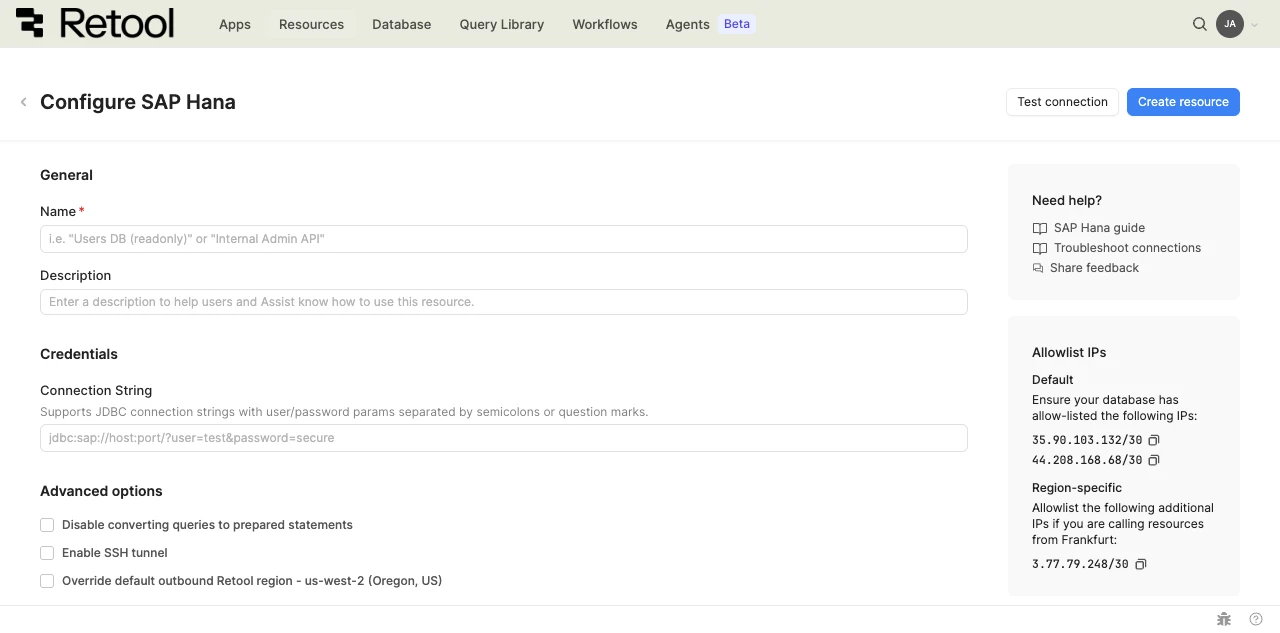
SAP HANA resource configuration form.
Configure general settings
Specify a name and description for the resource that indicates which database it connects to. The description provides more context to users about how to use the resource.
| Example name | Example description |
|---|---|
| Analytics HANA | The production SAP HANA database used for analytics reporting. |
| Sales HANA (read-only) | A read-only SAP HANA database containing sales transaction data. |
Configure resource credentials
Configure the connection settings for your SAP HANA resource.
Connection string
Provide a JDBC connection string that includes your SAP HANA instance's host, port, and credentials.
jdbc:sap://host:port/?user=test&password=secure
Configure advanced options
Configure optional settings available under the Advanced options section of the resource configuration form.
Disable converting queries to prepared statements
By default, Retool uses prepared statements for SAP HANA queries, which improves performance and prevents SQL injection. Disable this option only if your SAP HANA setup does not support prepared statements.
SSH tunnel
If your SAP HANA instance is not publicly accessible, configure an SSH tunnel to connect through a bastion host. Provide SSH host, port, username, and authentication method (password or private key).
- Cloud
Outbound region
If your organization uses outbound regions, select the region that should be used for requests to SAP HANA. This controls which geographic region your requests originate from.
Test the connection
Click Test connection to verify Retool can connect to your SAP HANA instance. If the test succeeds, you see a success message. If it fails, check the following:
- Network access: Ensure your SAP HANA instance accepts connections from Retool's IP addresses or your self-hosted instance's network.
- Connection string: Verify the host, port, and credentials in your connection string are correct.
- SSH tunnel: If you configured an SSH tunnel, verify the bastion host is reachable and the tunnel credentials are correct.
After testing the connection, click View in console to open the Debug Tools console. The console displays detailed information about the test, including the test query executed, execution time, and error details if the test fails.
Save the resource
Click Create resource to save your SAP HANA resource. You can now use it in queries across your Retool apps and automations.
Interact with SAP HANA data
Once you've created a SAP HANA resource, you can interact with SAP HANA data using Retool.
SAP HANA isn't yet supported in the new app builder. Use a classic app, workflow, or agent instead.
For classic apps, workflows, and agents, refer to the SQL queries documentation to learn how to write a resource query.
Best practices
Follow these best practices to maintain the security of your SAP HANA resource.
- Store credentials securely: Retool encrypts your SAP HANA connection string automatically, so you don't need to route it through a separate secrets store.
- Use a read-only user for read-heavy resources: Create a dedicated database user with only the permissions a resource actually needs, and use a read-only user for resources that only query data.
- Use an SSH tunnel for private databases: Keep your SAP HANA instance off the public internet and connect through an SSH tunnel instead.
- Use resource environments: Organizations on an Enterprise plan can configure multiple resource environments to maintain separate SAP HANA credentials for production, staging, and development.
Related resources
Create a resource
Learn how to create and manage resources in Retool.
SSH tunnels
Connect to databases that aren't publicly accessible.
Resource environments
Configure separate credentials for production and non-production environments.
Retool community: SAP HANA
Community discussions and solutions for SAP HANA integrations.
SAP HANA SQL reference
Official SAP HANA SQL reference documentation.